control valve,Electric contrPneumaticol valve,Pneumatic ball valve-Control valve manufacturer


Mobile:+86-17717520739
Wechat:17717520739
Email:info@shxvalve.com
Address: NO.720, Suide Road, Jiading District,Shanghai, China.




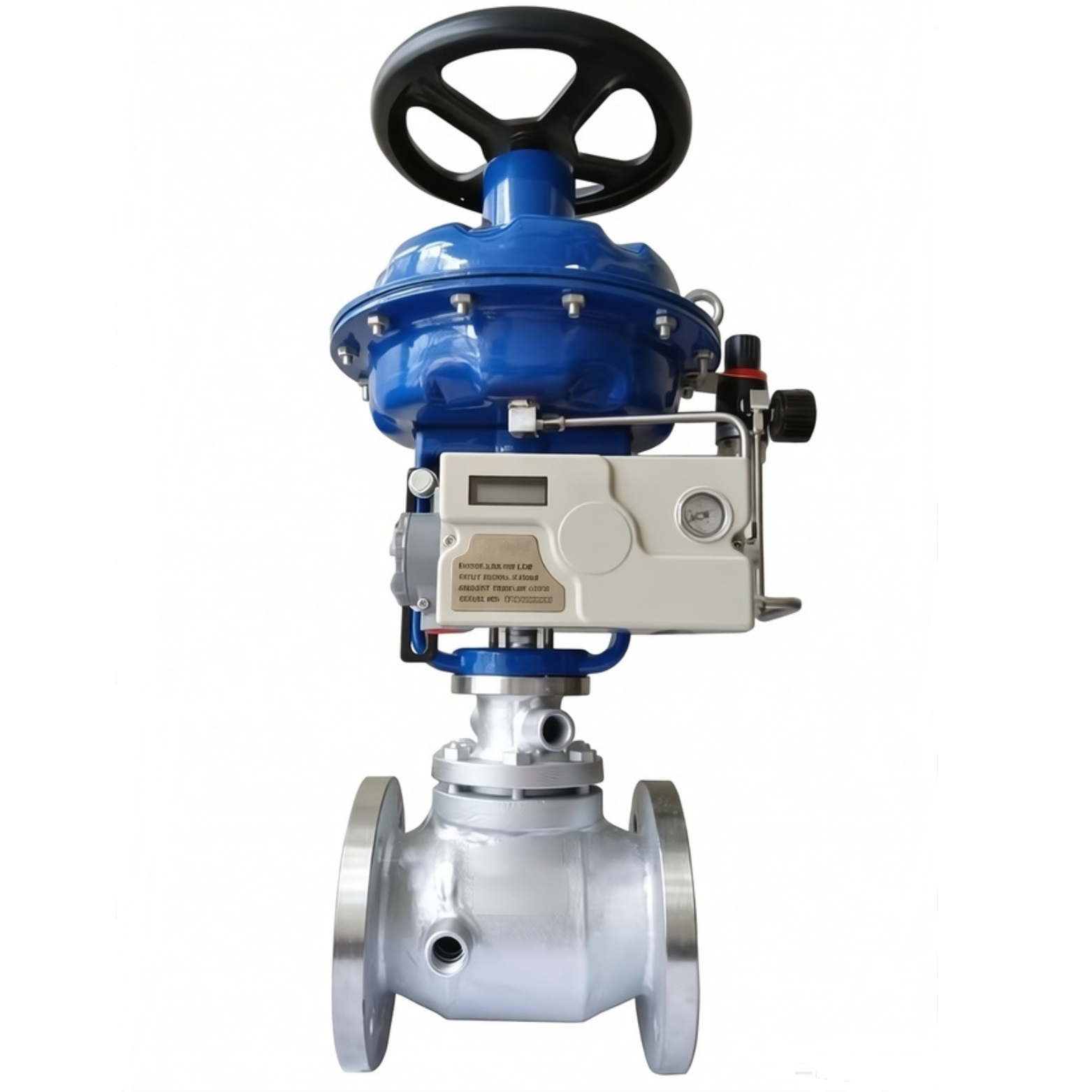

Model:
Pneumatic jacket control valve manufacturer, factory and supplier. Pneumatic jacket control valve is a linear-stroke process regulation equipment composed of a pneumatic diaphragm actuator and a jacketed thermal-insulated valve body. Based on the basic throttling structure of traditional single-seat or sleeve control valves, Pneumatic jacket control valve adds an integral external jacket cavity outside the valve body and bonnet, which is the most distinctive structural feature different from ordinary control valves. The jacket cavity of Pneumatic jacketed control valve can pass through heating media such as saturated steam and hot thermal oil or cooling media such as chilled water and cold brine, forming a closed temperature-control circulation layer outside the internal process flow channel.
Driven by compressed air and matched with intelligent valve positioners and auxiliary accessories, the pneumatic jacket control valve receives 4–20mA electric control signals or 20–100kPa pneumatic signals to adjust fluid flow, pressure and liquid level parameters. Meanwhile, it relies on the jacket temperature control system to stabilize the medium operating temperature within the set range, preventing medium crystallization, solidification and viscosity fluctuation. With intrinsic explosion-proof performance of pneumatic drive and professional thermal insulation and anti-blocking capability, Pneumatic jacketed control valve is the exclusive preferred equipment for automatic regulation of temperature-sensitive and easy-solidifying media in industrial production, filling the technical gap of ordinary control valves in special working condition adaptation.
In modern process industries involving viscous, easy-crystallizing, temperature-sensitive and low-freezing media, conventional pneumatic single-seat and sleeve control valves often face fatal operational problems such as medium solidification, pipeline blockage, valve jamming and inaccurate regulation due to ambient temperature changes and heat loss. As a specialized temperature-maintaining automatic regulation device, the pneumatic jacket control valve integrates a standard pneumatic actuator and a full-body jacketed thermal insulation valve structure. By circulating heating or cooling medium inside the external jacket layer, it maintains a constant operating temperature of the internal process fluid, completely solving the industrial pain points of medium condensation, crystallization and viscosity increase caused by heat dissipation. With dual functions of precise flow regulation and constant temperature maintenance, Pneumatic jacket control valve is widely used in petrochemical, fine chemical, pharmaceutical, asphalt processing and chemical new energy industries. This paper systematically elaborates on the structural composition, core thermal insulation mechanism, working principle, classification characteristics, performance advantages, industrial application scenarios, engineering selection criteria and full-life cycle maintenance strategies of pneumatic jacketed control valves, providing standardized technical support for temperature-sensitive fluid automatic control system design and on-site stable operation management.
The pneumatic jacket control valve is a special high-performance automatic regulation device optimized for temperature-sensitive, easy-crystallization and high-viscosity industrial media. Its unique integral jacket circulating temperature control structure makes up for the inherent defects of ordinary control valves in special medium regulation, realizing the dual integration of precise fluid throttling and constant-temperature anti-blocking protection. With the comprehensive advantages of stable medium state, high regulation accuracy, strong anti-jamming capability and safe and reliable operation, it has become indispensable core equipment in petrochemical, fine chemical, pharmaceutical and new energy process systems.
With the continuous development of industrial automation and intelligent temperature control technology, pneumatic jacketed control valve will continue to achieve breakthroughs in intelligent linkage control, energy-saving structural optimization and extreme working condition adaptation. Through scientific type selection, standardized installation and refined full-life maintenance, the equipment can give full play to its exclusive constant-temperature regulation performance, effectively solve the production pain points of medium crystallization, solidification and pipeline blockage, and provide stable, efficient and safe technical support for the stable operation and quality improvement of modern special process industrial production, with broad application prospects and sustainable development value.
Pneumatic jacket control valve Structural Composition
The complete pneumatic jacket control valve consists of three core functional modules: pneumatic actuator assembly, jacketed temperature-control valve body assembly and professional supporting accessories. Each module cooperates independently and synergistically, realizing dual core functions ofprecise fluid throttling regulation and constant temperature thermal insulation protection. The overall structure complies with IEC and industrial valve design standards, featuring compact layout, good thermal insulation uniformity and convenient disassembly, maintenance and medium replacement.
2.1 Pneumatic Actuator Assembly
Consistent with mainstream industrial control valve configuration, the standard matching power unit is a multi-spring pneumatic diaphragm actuator, with individual high-load and large-diameter working conditions equipped with piston pneumatic actuators. The multi-spring symmetric layout ensures stable output thrust and excellent linear matching with control signals, effectively overcoming medium resistance and mechanical friction to realize accurate linear stroke adjustment.
The actuator is divided into air-to-open (fail-close) and air-to-close (fail-open) types according to industrial safety design specifications. The fail-close type automatically cuts off fluid flow when the air source fails or power is lost, suitable for dangerous temperature-sensitive media to avoid leakage and solidification accidents; the fail-open type maintains pipeline circulation under failure conditions, applicable to process systems that prohibit pipeline emptying and medium solidification residue. The actuator is installed on the top of the jacketed bonnet through standard connecting brackets, with isolated structural design to avoid the influence of jacket high temperature or low temperature on the internal spring and diaphragm components.
2 Core Jacketed Valve Body Assembly
The jacketed valve body assembly is the core functional component that distinguishes jacketed control valves from ordinary valves, including internal throttling components (valve plug, valve seat, valve stem), main flow channel valve body, external integral thermal insulation jacket, jacket medium inlet and outlet ports, and sealed bonnet. The dual-layer structure of inner flow channel and outer temperature-control cavity realizes complete cladding of the valve body and bonnet, ensuring no dead angle for temperature control.
The internal throttling structure adopts mature single-seat or sleeve throttling design. The single-seat type features excellent tight shut-off performance, suitable for small-flow and strict sealing working conditions; the sleeve type has balanced pressure structure and strong anti-vibration capability, applicable to high-differential-pressure and large-flow temperature-sensitive medium regulation. The internal flow channel adopts streamlined optimization design to reduce fluid turbulence and adhesion, cooperating with external thermal insulation to further avoid medium deposition and blockage.
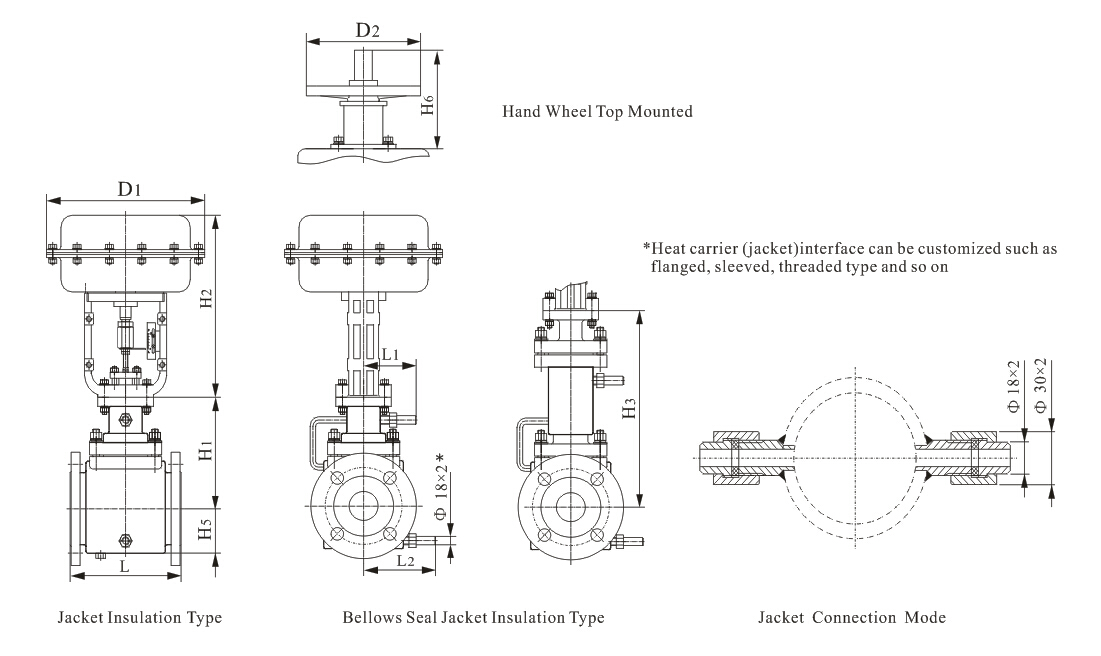
The external integral jacket is made of high-strength carbon steel or stainless steel, welded and sealed with the inner valve body to form a closed annular cavity. Two standard interface ports are reserved on the jacket wall for temperature-control medium inlet and outlet, realizing circulating heating or cooling. The full-cladding jacket design covers the entire valve body and bonnet, ensuring uniform temperature of all fluid contact parts, and avoiding local temperature drop leading to partial medium crystallization and blockage.
The bonnet is integrated with the jacket structure to realize overall thermal insulation. The packing box adopts high-temperature resistant or low-temperature resistant composite sealing packing to adapt to different jacket temperature working conditions, ensuring no external leakage of process medium and no mutual leakage between temperature-control medium and process medium. Valve body materials are selected according to medium characteristics, including WCB carbon steel, 304/316L stainless steel and fluorine-lined anti-corrosion materials, adapting to corrosive, viscous and high-purity temperature-sensitive media.
3 Supporting Auxiliary Accessories
To meet the requirements of automatic precision regulation and stable temperature control operation, pneumatic jacketed control valves are equipped with complete supporting accessory systems. The intelligent valve positioner is the core regulation accessory, realizing closed-loop stroke calibration, eliminating mechanical hysteresis and friction errors, and improving positioning accuracy up to ±0.3% FS. The air filter regulator stabilizes the air source pressure and purifies compressed air to ensure stable actuator operation.
Different from ordinary control valves, jacketed valves are additionally matched with temperature control valve groups, pressure gauges and flow meters for jacket medium circulation, which can adjust the flow and pressure of heating/cooling medium in real time according to ambient temperature and process medium temperature changes, realizing automatic constant temperature control. Meanwhile, emergency solenoid valves, stroke limit switches and manual handwheel mechanisms are configured to improve equipment safety redundancy and remote monitoring capability, meeting the interlock protection requirements of temperature-sensitive process systems.
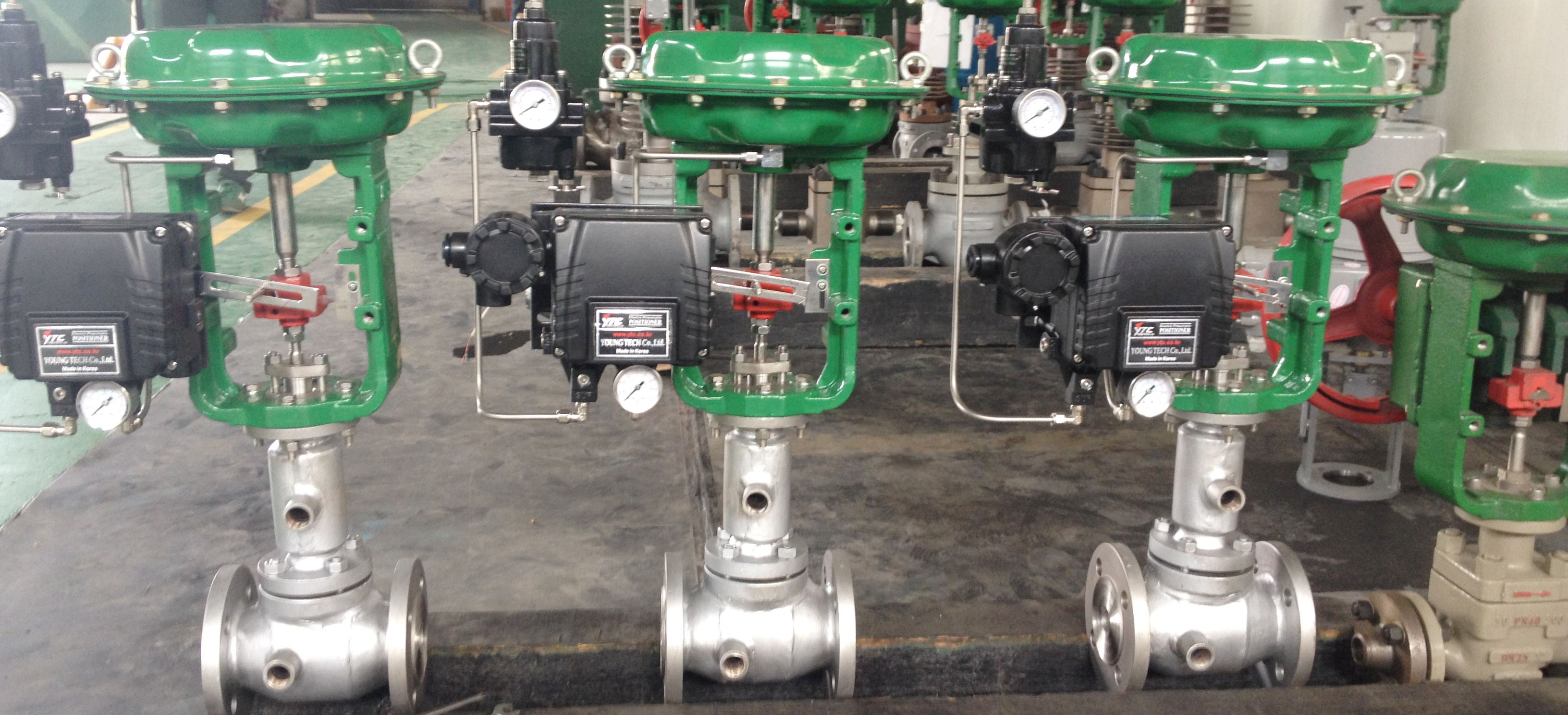
Pneumatic jacket control valve Structure
Pneumatic jacket control valve Material
|
Component name |
control valve Material |
|
Body/Bonnet |
WCB/WCC/WC6/CF8/CF8M/CF3M |
|
Valve spool/Seat |
304/316/316L(overlaying stellite alloy) |
|
Packing |
Normal:-196~150℃ is PTFE,RTFE,>230℃ is flexible graphite |
|
Gasket |
Normal:Stainless steel with flexible graphite,Special:Metal tooth type gasket |
|
Diaphragm Cover |
Normal:Q235,Special:304 |
|
Diaphragm |
NBR with reinforced polyester fabric |
|
Spring |
Normal:60Si2Mn,Special:50CrVa |
|
Control valve stem |
2Cr13/17-4PH/304/316/316L |
Pneumatic jacket control valve Performance
|
Pneumatic jacket control valve |
Linear, percentage, quick open |
|
|
Allowable range |
50: 1 (CV<6.3 30: 1) |
|
|
Rated Cv value |
Percentage CV1.6~630 ,linear CV1.8~690 |
|
|
Pneumatic steam jacketed control valve Allowable leakage |
Metal seal: IV grade(0.01% rated capacity) |
|
|
Pneumatic jacketed control valve Performance |
||
|
Intrinsic error % |
±1.5 |
|
|
Return difference, % |
≤1.5 |
|
|
Dead zone, % |
≤0.6 |
|
|
Difference from beginning to end point, % |
±2.5 |
|
|
Rated travel difference, % |
≤2.5 |
|
Pneumatic jacket control valve
ZJHM Pneumatic cage control valve
ZJHP Pneumatic single seat control valve
PN25 25 Bar Flanged end solenoid valve
30Bar 3MPa Water flanged solenoid valve
42MPa 420Bar High Pressure Solenoid Valve
PN250 250Bar 25Mpa Solenoid Valve
200Bar 20Mpa 304SS 316SS Solenoid Valve
Address :No.720 Suide Road,Jiading district,Shanghai,China
Tel:+86-17717520739
Wechat:17717520739
Email:info@shxvalve.com



 微信扫一扫 添加我为好友了解更多  |
