control valve,Electric contrPneumaticol valve,Pneumatic ball valve-Control valve manufacturer


Mobile:+86-17717520739
Wechat:17717520739
Email:info@shxvalve.com
Address: NO.720, Suide Road, Jiading District,Shanghai, China.




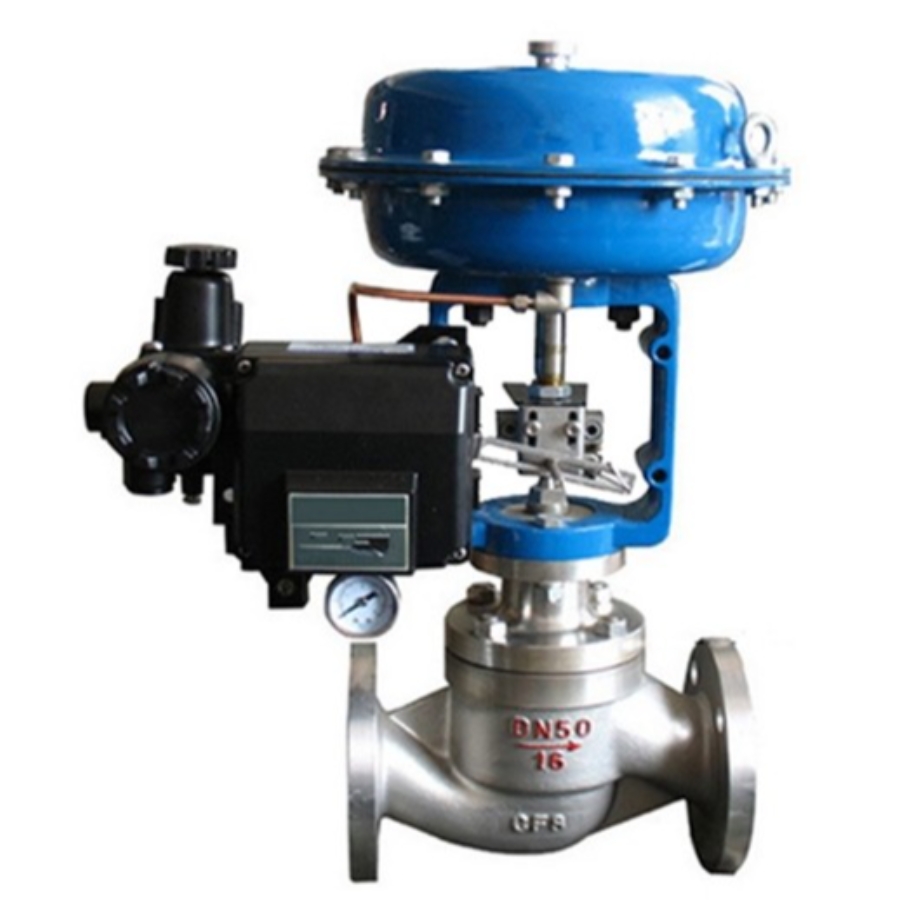

Model:
ZJHP Pneumatic single seat control valve is a linear-motion process control valve integrating a pneumatic actuator and a single-seat valve body. Different from double-seat and multi-seat control valves, ZJHP Pneumatic single seat control valve adopts a single plug and single seat sealing structure, with only one fluid sealing pair inside the valve body. Equipped with a diaphragm or piston pneumatic actuator, ZJHP Pneumatic single seat control valve receives standard pneumatic signals (20–100kPa) or electric control signals (4–20mA matched with a valve positioner) to drive the valve stem and plug for linear up-and-down movement. By changing the flow passage area between the plug and the seat, it realizes continuous and precise adjustment of fluid medium flow, pressure and differential pressure.
As a terminal execution unit of the process control system, ZJHP Pneumatic single seat control valve directly contacts with process media including liquid, gas and steam. It undertakes the critical task of converting control system commands into actual process parameter changes. Compared with electric and hydraulic control valves, the pneumatic type features intrinsic explosion-proof performance, low operation cost, strong environmental adaptability and no risk of electrical failure, which makes it more suitable for flammable, explosive, high-temperature and high-pressure harsh industrial environments.
ZJHP Pneumatic single seat control valve Structural Composition
The complete ZJHP Pneumatic single seat control valve is mainly composed of two core parts: pneumatic actuator andsingle-seat valve body assembly, supplemented by auxiliary accessories such as valve positioner, air filter regulator, solenoid valve, limit switch and packing sealing components. Each module cooperates closely to ensure stable signal response, accurate displacement execution and reliable medium sealing.
1 Pneumatic Actuator Assembly
The actuator of ZJHP Pneumatic single seat control valve is the power source of the control valve, responsible for converting pneumatic energy into mechanical linear thrust to drive the valve core movement. The mainstream type is the spring-diaphragm actuator, which features simple structure, stable output force and good linear matching with control signals. A few high-thrust working conditions adopt piston pneumatic actuators.
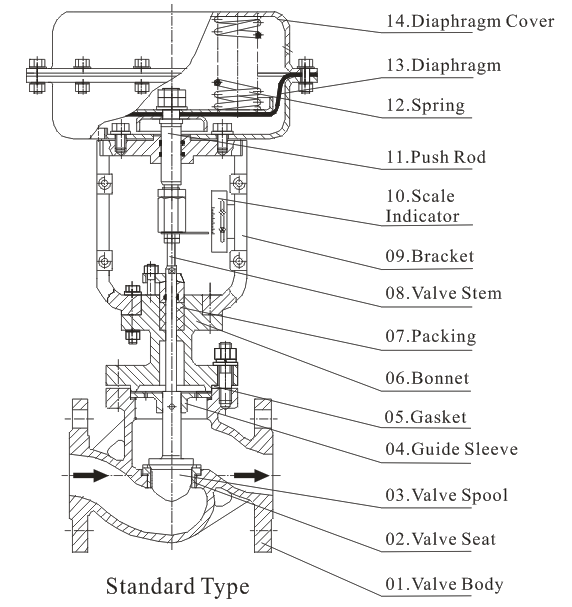
The spring-diaphragm actuator consists of a upper membrane cover, lower membrane cover, rubber diaphragm, actuator spring, spring seat, push rod and air inlet interface. The diaphragm divides the actuator inner cavity into a sealed air pressure chamber and a spring reset chamber. When compressed air enters the air pressure chamber, air pressure acts on the diaphragm to generate downward thrust, overcoming the spring preload and medium unbalanced force to push the push rod down; when the air pressure decreases, the spring rebounds to drive the push rod to reset upward, realizing automatic reset of the valve.
According to the action mode, actuators are divided into air-to-open and air-to-close types. The air-to-open valve opens when air pressure increases and closes when air pressure disappears (fail-close), which is suitable for process working conditions requiring safety shutdown during air source failure; the air-to-close valve closes when air pressure increases and opens when air pressure disappears (fail-open), applied to working conditions requiring continuous fluid passage during equipment failure.
2 Single-Seat Valve Body Assembly
ZJHP Pneumatic single seat control valve body assembly is the fluid regulation and sealing core, directly bearing medium pressure and flow impact, mainly including valve body, valve seat, valve plug (valve core), valve stem, bonnet and packing box. The overall flow channel adopts an S-shaped streamlined design, which effectively reduces fluid turbulence and pressure drop, optimizing medium flow state.
ZJHP Pneumatic single seat control valve seat is fixed at the bottom of the valve body, forming a precise sealing pair with the upper valve plug. The single-seat structure achieves zero leakage tight shut-off more easily than double-seat valves, meeting the strict shut-off requirements of most precision process working conditions. The valve plug is connected with the actuator push rod through the valve stem, adopting top-guided or upper-and-lower double-guided positioning structure, which ensures high straightness of linear movement, avoids plug deflection and jamming, and improves regulation stability.
The packing box is arranged at the bonnet position, filled with graphite, PTFE and other high-performance sealing packing, which effectively prevents medium leakage from the valve stem gap and ensures the tightness of the valve body under high pressure and high temperature working conditions. The bonnet plays a role of fixing the valve stem guide and protecting the internal sealing structure, with different structural designs such as standard type, high-temperature extension type and low-temperature cold insulation type adapted to different working conditions.
3 Core Auxiliary Accessories
Auxiliary accessories are key to improving the control accuracy and operational reliability of the valve. ZJHP Pneumatic single seat control valve positioner is the core accessory, which receives 4–20mA electric signals or pneumatic signals, compares the signal value with the actual valve stem displacement, and dynamically adjusts the actuator air intake pressure to realize precise positioning of the valve plug, eliminating the errors caused by spring hysteresis and medium unbalanced force.
The air filter regulator stabilizes the input air source pressure and filters moisture and impurities in compressed air, avoiding air source fluctuation and pollution affecting valve action. The solenoid valve is used for emergency cut-off and switching control, realizing rapid valve opening and closing in case of system failure. The limit switch feeds back the full-open and full-close state signals of the valve to the control system, realizing remote state monitoring.
ZJHP Pneumatic single seat control valve Working Principle
The working process of the ZJHP pneumatic single seat control valve follows the closed-loop control logic of signal input-pneumatic conversion-mechanical displacement-fluid regulation, realizing continuous and stepless adjustment of process parameters. The complete working mechanism is divided into three core links:
3.1 Signal Receiving and Pneumatic Conversion
The industrial automatic control system outputs standard 4–20mA analog electric signals according to the set process parameters and actual detection deviation. After receiving the electric signal, the valve positioner converts it into a proportional pneumatic pressure signal. The signal pressure corresponds one-to-one with the valve opening: 4mA corresponds to full closed state, 20mA corresponds to full open state, and intermediate signals correspond to different intermediate openings.
3.2 Actuator Thrust Output and Displacement Execution
The converted pneumatic signal enters the actuator air pressure chamber, and the air pressure acts vertically on the flexible diaphragm to form effective thrust. When the thrust is greater than the combined resistance of the actuator spring preload, valve stem friction and medium unbalanced force, the diaphragm drives the push rod and valve stem to produce linear displacement. The change of input air pressure directly controls the displacement stroke of the valve stem, realizing accurate adjustment of the valve plug lifting height.
3.3 Fluid Flow Regulation and Parameter Stabilization
The lifting or descending of the valve plug changes the annular flow passage area between the plug and the seat. When the valve plug rises, the flow area increases, medium flow rate rises; when the valve plug descends, the flow area decreases, flow rate drops, and the valve is completely closed when the plug is fully fitted with the seat. Through real-time dynamic adjustment of the flow area, the valve continuously corrects the deviation of process parameters such as pipeline flow, pressure and liquid level, and finally realizes the stable operation of the process system within the set parameter range.
In terms of force balance principle, the valve maintains dynamic force balance during stable operation: the air pressure thrust of the actuator is equal to the spring reset force, medium unbalanced force and friction resistance. Once the control signal or medium working condition changes, the force balance is broken, and the valve automatically adjusts the opening until a new force balance is formed, ensuring high stability of control accuracy.
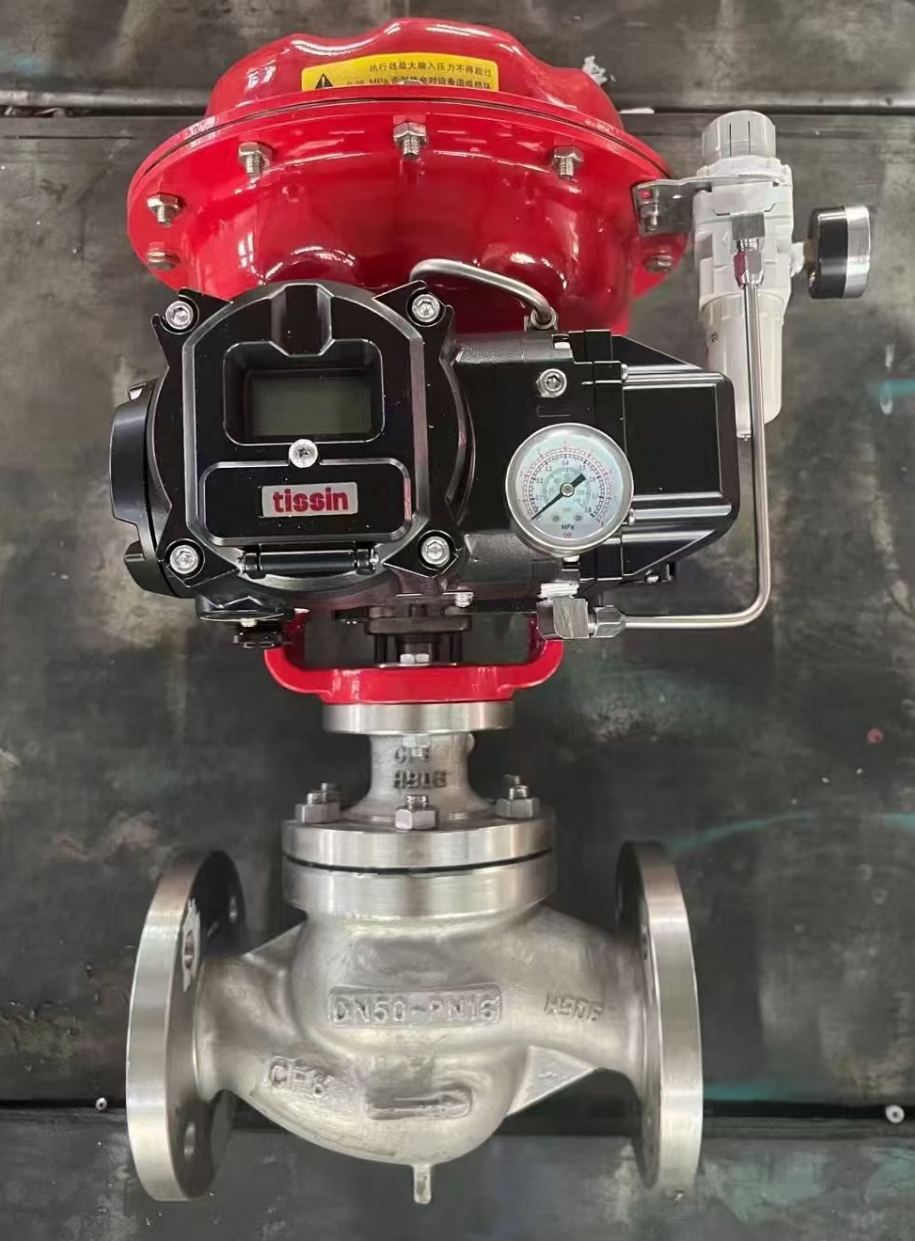
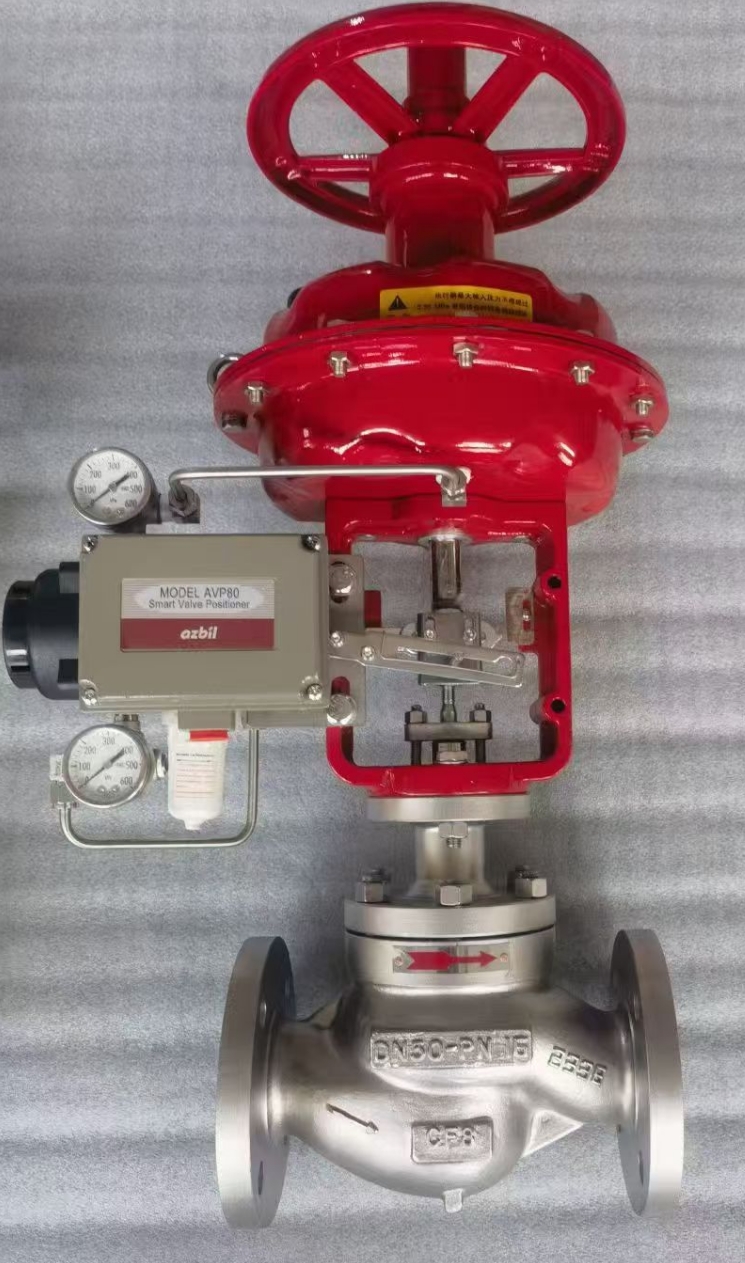
ZJHP Pneumatic single seat control valve Structure
How to choose ZJHP Pneumatic single seat control valve?
Reasonable valve selection is the premise to ensure the regulation performance and service life of ZJHP pneumatic single seat control valves. The selection needs to comprehensively consider process working conditions, medium characteristics and control requirements, focusing on the following key parameters and principles.
1 Working Condition Parameter Matching
Determine the ZJHP Pneumatic single seat control valve nominal diameter and pressure grade according to pipeline design flow, working pressure and working temperature. The flow coefficient (Cv value) is the core parameter of valve selection, which needs to ensure that the valve works in the optimal stroke range (30%–70% stroke) under rated working conditions, avoiding long-term operation at full opening or small opening to prevent regulation instability and medium erosion. For high differential pressure working conditions, the unbalanced force of the medium shall be checked to select the actuator with matching thrust to ensure reliable valve closing.
2 Medium Characteristic Adaptation
Select valve body and sealing materials according to medium properties. For conventional water and gas media, carbon steel valve body and PTFE seal can be used; for corrosive media such as strong acid and alkali, 304/316L stainless steel or fluorine-lined anti-corrosion structure is required; for high-temperature steam media, metal hard seal and high-temperature resistant alloy materials are adopted; for viscous and easy-crystallization media, streamlined valve body and anti-blocking structural design are selected.
3 Control and Safety Requirements
Select flow characteristics of ZJHP Pneumatic single seat control valve according to process regulation requirements: equal percentage characteristic for most flow and pressure precision regulation, linear characteristic for liquid level and fixed-value regulation, quick-opening characteristic for on-off interlock control. Determine the action mode according to safety interlock logic: fail-close type for dangerous working conditions to prevent medium overflow, fail-open type for continuous circulation working conditions to prevent pipeline dry burning and emptying. Match corresponding auxiliary accessories such as positioner, filter regulator and limit switch according to the control system signal type and remote monitoring requirements.
ZJHP Pneumatic single seat control valve Performance
|
Pneumatic single seat control valve |
Linear, percentage, quick open |
|
|
Allowable range |
50: 1 (CV<6.3 30: 1) |
|
|
Rated Cv value |
Percentage CV1.6~630 ,linear CV1.8~690 |
|
|
Pneumatic control valve Allowable leakage |
Metal seal: IV grade(0.01% rated capacity) |
|
|
ZJHP Pneumatic single seat control valve Performance |
||
|
Intrinsic error % |
±1.5 |
|
|
Return difference, % |
≤1.5 |
|
|
Dead zone, % |
≤0.6 |
|
|
Difference from beginning to end point, % |
±2.5 |
|
|
Rated travel difference, % |
≤2.5 |
|
ZJHP Pneumatic single seat control valve actuator parameter
|
Control Valve Type\ Method |
Pneumatic diaphragm actuator |
|
ZH23~ZH56 |
|
|
Multi-spring type |
|
|
Usage |
Regulating type, ON-OFF type |
|
Air supply pressure or Power supply voltage |
Air supply pressure (Spring range) |
|
Connector |
Air pipe connector: RC1/4 |
|
Direct action |
Pressure increase, stem descend, valve close. |
|
Reaction |
Pressure increase, stem ascend, valve open. |
|
Input signal |
40~20mA.DC(with positioner) |
|
Lag |
≤1%FS(with positioner) |
|
Linear type |
2%FS(with positioner) |
|
Environmental temperature |
-10℃~+70℃ |
|
Pneumatic control valve |
E/P, P/P valve positioner, filter regulator, valve converter, solenoid valve, limited switch |
ZJHP Pneumatic single seat control valve technical parameter
|
Seat diameter(mm) |
10 |
12 |
15 |
20 |
25 |
32 |
40 |
50 |
65 |
80 |
100 |
125 |
150 |
200 |
|
|
Rated Cv |
Percentage |
1.6 |
2.5 |
4.0 |
6.3 |
10 |
16 |
25 |
40 |
63 |
100 |
160 |
250 |
400 |
630 |
|
Linear |
1.8 |
2.8 |
4.4 |
6.9 |
11 |
17.6 |
27.5 |
44 |
69 |
110 |
176 |
275 |
440 |
690 |
|
|
Nom. size |
Travel |
Option flow characteristic Cv. (★standard ●recommanded ○customized) |
|||||||||||||
|
DN20 |
16mm |
● |
● |
● |
★ |
|
|
|
|
|
|
|
|
|
|
|
DN25 |
● |
● |
● |
● |
★ |
|
|
|
|
|
|
|
|
|
|
|
DN32 |
25 mm |
○ |
○ |
○ |
○ |
○ |
★ |
|
|
|
|
|
|
|
|
|
DN40 |
|
○ |
○ |
○ |
○ |
● |
★ |
|
|
|
|
|
|
|
|
|
DN50 |
|
|
○ |
○ |
○ |
● |
● |
★ |
|
|
|
|
|
|
|
|
DN65 |
40mm |
|
|
|
|
|
○ |
○ |
○ |
★ |
|
|
|
|
|
|
DN80 |
|
|
|
|
|
○ |
○ |
○ |
● |
★ |
|
|
|
|
|
|
DN100 |
|
|
|
|
|
○ |
○ |
○ |
● |
● |
★ |
|
|
|
|
|
DN125 |
60mm |
|
|
|
|
|
|
|
|
○ |
○ |
○ |
★ |
|
|
|
DN150 |
|
|
|
|
|
|
|
|
|
○ |
○ |
● |
★ |
|
|
|
DN200 |
|
|
|
|
|
|
|
|
|
○ |
○ |
● |
● |
★ |
|
|
Pneumatic actuator |
ZHA/B-22 |
ZHA/B-23 |
ZHA/B-34 |
ZHA/B-45 |
|||||||||||
|
350 |
350 |
560 |
900 |
||||||||||||
|
Action |
Spring range |
Metal sealing allowable pressure difference (MPa) |
|||||||||||||
|
Air open |
20-100KPa |
4.46 |
3.09 |
1.98 |
1.16 |
0.7 |
0.44 |
0.28 |
0.18 |
0.17 |
0.11 |
0.07 |
0.07 |
0.05 |
0.03 |
|
40-200 KPa |
6.4 |
6.4 |
5.94 |
3.34 |
2.14 |
1.31 |
0.84 |
0.53 |
0.51 |
0.33 |
0.21 |
0.22 |
0.15 |
0.09 |
|
|
80-240 KPa |
6.4 |
6.4 |
6.4 |
6.4 |
4.99 |
3.05 |
1.95 |
1.25 |
1.18 |
0.78 |
0.5 |
0.51 |
0.36 |
0.21 |
|
|
Air close |
20-100KPa |
6.4 |
6.19 |
3.96 |
2.23 |
2.14 |
0.87 |
0.56 |
0.35 |
0.34 |
0.22 |
0.14 |
0.15 |
0.1 |
0.06 |
|
40-200 KPa |
6.4 |
6.4 |
6.4 |
6.4 |
6.4 |
5.86 |
3.64 |
2.3 |
2.21 |
1.43 |
0.91 |
0.95 |
0.66 |
0.37 |
|
|
80-240 KPa |
6.4 |
6.4 |
6.4 |
6.4 |
6.4 |
6.4 |
5.04 |
3.18 |
3.06 |
1.98 |
1.26 |
1.32 |
0.92 |
0.5 |
|
Pneumatic jacket control valve
ZJHM Pneumatic cage control valve
ZJHP Pneumatic single seat control valve
PN25 25 Bar Flanged end solenoid valve
30Bar 3MPa Water flanged solenoid valve
42MPa 420Bar High Pressure Solenoid Valve
PN250 250Bar 25Mpa Solenoid Valve
200Bar 20Mpa 304SS 316SS Solenoid Valve
Address :No.720 Suide Road,Jiading district,Shanghai,China
Tel:+86-17717520739
Wechat:17717520739
Email:info@shxvalve.com



 微信扫一扫 添加我为好友了解更多  |
